Green space is not a luxury — but Public health

A Finnish study adds striking evidence to something many of us intuitively know: contact with urban nature isn’t a luxury, it’s a Public health strategy with measurable mental and physical health benefits. It’s no surprise that researchers around the world are no longer just tracking whether people experience anxiety or depression, but why these conditions are rising — and what cities can do about it. What did the Finnish study find? Researchers analyzed responses from more than 16,000 residents in Helsinki and the surrounding area. They found that people who visited parks, community gardens, forests, or other green spaces three to four times a week had significantly lower use of prescription drugs compared to those who visited less than once a week: 33% lower odds of using medication for anxiety, depression, or insomnia 36% lower odds of use of hypertension medication 26% lower odds of using asthma medication What really stood out was that the strongest benefits were seen among lower-income residents, suggesting that access to green space could help reduce health inequalities — not just medication use. Prescription drug use was used as a proxy for ill health, meaning people spending more time in nature tended to rely less on medications for mental stress and cardiovascular conditions. Why this matters now These findings land at a time when mental health challenges are increasing worldwide: Nearly 1 billion people worldwide live with a mental disorder such as anxiety or depression (World Health Organization – WHO). The COVID-19 pandemic triggered an estimated 25% rise in anxiety and depression in its first year (WHO). Urban living — with its density, noise, pollution, and social isolation — is consistently linked to higher rates of stress-related mental health conditions (World Economic Forum). Together, this tells me that cities need solutions beyond clinics and prescriptions — solutions that address environmental and social stressors at their roots. Green space as a Public health investment Spending time in parks and gardens appears to reduce stress even without intense physical activity. And because lower-income communities often have the least access to quality green space, investing in these environments can also promote health equity. With more than half the world’s population now living in cities — a figure expected to approach 60% by 2030 — the mental health burden of urban life will only grow without structural interventions. What this means for Urban Planning Urban planning needs to treat green space as essential infrastructure. That means: Ensuring everyone can reach a green or blue space within walking distance, Designing spaces that feel safe, inclusive, and well maintained Correcting inequities in where green space is located Integrating greenery into every day routes, not just destination parks Supporting initiatives like social prescribing that encourage time outdoors A question for all of us This research reinforces a simple but powerful idea: nature supports health in measurable ways, including reduced reliance on medication. As mental health pressures continue to rise, cities have both an opportunity and a responsibility to design for well-being. So, the question is: what can citizens do — or get involved in — to ensure city planners and public officials take this kind of research seriously when planning for the future? In an era of rising anxiety and depression, urban green space is more than beauty. It is prevention. Reference: Turunen, A. W., Halonen, J., Korpela, K., Ojala, A., Pasanen, T., Siponen, T., Tiittanen, P., Tyrväinen, L., Yli-Tuomi, T., & Lanki, T. (2023). Cross-sectional associations of different types of nature exposure with psychotropic, antihypertensive and asthma medication. Occupational and environmental medicine, 80(2), 111–118. https://doi.org/10.1136/oemed-2022-108491
INFTA completed innovative research project
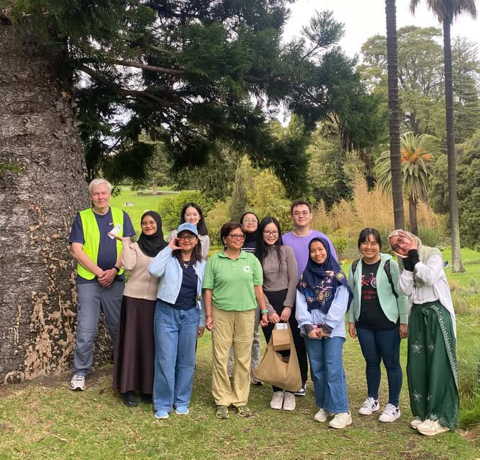
INFTA has successfully completed the data collection for the research project termed “Effective Stress Reduction in Nature“. This project aimed at effectively bringing down stress levels of international students to improve their mental and physical health. It was partially funded by a grant of the Department of Jobs, Skills, Industry and Region in Victoria. It was part of the Study Melbourne Inclusion Program which has funded 162 projects to the value of $7.3 million and supported more than 235,000 international students since its inception in 2015. INFTA led a consortium of researchers and executive staff from Deakin University, RMIT, Federation University and the Royal Botanic Gardens Melbourne. Free Forest Therapy sessions were offered to international students in Melbourne but also in Ballarat and Geelong so that students studying at regional campuses were able to take part. Ethics clearance for this important clinical trial was obtained from the regional health provider, Barwon Health. We thank all international students who supported this research project. A summary report will be provided to international students at the end of January 2026 with an international publication in a Q1 journal to follow during the first half of this year.
Forest Therapy – effective in Germany

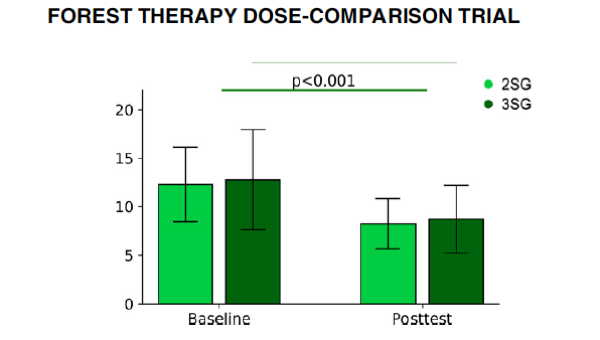
INFTA is proud about the release of the first scientific article which underscores the effectiveness of Forest Therapy in Germany. In 2020 and on the initiative of INFTA’s Secretary & International Strategic Advisor, Dr. Dieter Kotte, INFTA (Germany) and Charité Berlin teamed up to conduct the first national research project in Forest Therapy, federally funded through the Waldklimafonds in Germany. The article “Effects of Forest Therapy on Participant-Reported Outcomes: A Randomized Controlled Dose-Comparison Trial Among the General Population in Germany” summarizes the findings which have just been published internationally in the Journal of Integrative and Complementary Medicine. The results underscore the effectiveness of INFTA’s standardized Forest Therapy sessions and pave the way for further clinical studies to determine, for example, the most appropriate dosage for patients/people with mental health issues. Furthermore, the results also strongly endorse the use of standardized Forest Therapy sessions for prevention of lifestyle-related diseases. Overall, the findings from the national German research underline the effectiveness and applicability of Forest Therapy as an evidence-based Public health practice.
INFTA receives important research grant
INFTA has been awarded another grant by the Department of Jobs, Skills, Industry and Region in Victoria. The proposed research project termed “Effective Stress Reduction in Nature” aims at effectively bringing down stress levels of international students to improve their mental and physical health. It is part of the Study Melbourne Inclusion Program which has funded 162 projects to the value of $7.3 million and supported more than 235,000 international students since its inception in 2015. INFTA leads a consortium of researchers and executive staff from Deakin University, RMIT, Federation University and the Royal Botanic Gardens Melbourne. Free Forest Therapy sessions will not only be offered to international students in Melbourne but also, as a major step forward, in Ballarat and Geelong so that students studying at regional campuses can also take part. Data collection is scheduled for the second half of 2025. Ethics clearance for this important clinical trial will be sought from the regional health provider, Barwon Health. We thank Study Melbourne for its ongoing support.
INFTA’s fact-finding mission in Taiwan
In March 2025, INFTA‘s Executive Committee members, Susan Joachim and Dr. Dieter Kotte, were invited by the Forestry and Nature Conservation Agency (FANCA), Ministry of Agriculture, to Taiwan on a fact-finding mission learn about Forest Therapy in Taiwan. The mission was organized by the Taiwan Forest Therapy Society. At a symposium conducted at FANCA’s headquarter in Taipei, FANCA’s Director General, Dr. Hwa-Ching Lin, welcomed INFTA’s representatives and expressed his hope that Forest Therapy – as an evidence-based Public health practice – could be developed further in Taiwan as a result of this mission. This expectation was shared wholeheartedly by Susan Joachim and Dr. Dieter Kotte.
INFTA’s fact-finding mission in Japan
In November 2024, INFTA‘s Executive Committee members, Susan Joachim and Dr. Dieter Kotte, were invited to Japan on a fact-finding mission to reset and restart Forest Therapy – referred to as “Shinrin-yoku” (森林浴) in Japanese. Invited by a group of business people, several site visits within the Tokyo Prefecture were conducted to evaluate their suitability for Forest Therapy. Among the places inspected were Hinohara Tomin-no-Mori, Showa Emperor Memorial Park and Komine Park in the West of Tokyo City. The Mayor of Hinohara-mura, Mr. Koji Yoshimoto, welcomed INFTA’s representatives in his office on 28 November 2024 and expressed his hope that health & wellbeing tourism could and will be strengthened in his region as a result of this mission.
INFTA leads important research
INFTA led a research group in Australia conducting an important clinical study. The aim of this project – funded with a grant by the Department of Jobs, Skills, Industry and Region in Victoria – was to bring down stress levels of international students to improve their mental and physical health. Some 350 international students registered for one of 12 Forest Therapy sessions carried out between August and October 2024 at the centrally-located Royal Botanical Gardens Melbourne. The satisfaction level of students with Forest Therapy was overwhelming: an impressive 96.0 percent. More so the tension of international students dropped by more than 40%, their fatigue by more than 30% and their vigor increased by more than 20% after the standardized two-hour Forest Therapy session. As a result, Forest Therapy was recommended as a regular, evidence-based, effective and affordable intervention to alleviate stress and anxiety among (international) students.
Forest Therapy Guide Training in Victoria
The Institute of Forest Therapy, INFTA’s Accredited Training Provider in Australia, conducted another successful exclusive five-day, in-person workshop at Pallotti College in Victoria/Australia. Getting exposed to various weather conditions allowed the participants to familiarize themselves with the natural conditions Forest Therapy Guides experience when guiding participants outdoors in different seasons. Bringing together a wide range of professional competencies, the new training cohort began their six-months training highly motivated with a lot of team spirit. While the learning curve was steep – David Belli, IFT’s Lead Trainer conducted the practical learning components while INFTA’s Secretary & International Strategic Advisor, Dr. Dieter Kotte, was responsible for the overall conduct of the seminar and the theoretical learning components – everyone enjoyed the unique experience at the tranquil and ideally located setting of Pallotti College as well as the hospitality of its staff.
1st Forest Therapy Guide Training in Japan
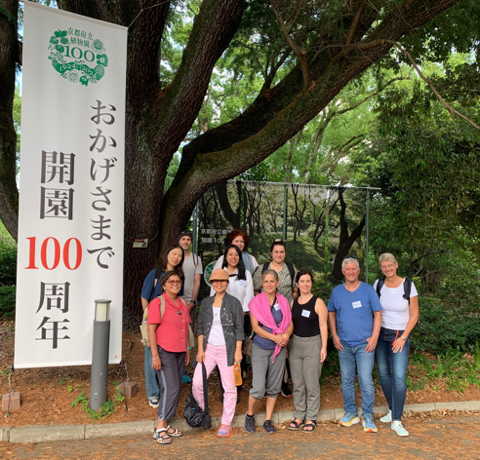
Finally, Forest Therapy has come to Japan – courtesy of INFTA and the Kyoto Botanical Gardens. As a special incentive for the Public celebrating its 100th anniversary, INFTA offered the world’s first Forest Therapy Guide training at the Kyoto Botanical Gardens. This exclusive international workshop was held 12-16 June 2024 with participants from Australia, China, Germany, Japan, Singapore, Spain and Vietnam. While it was possible for Japanese to obtain a Shinrin-yoku guide certificate through some short courses offered online, a full-fledged, six-months mentored and supervised training to become qualified as INFTA-Certified and Accredited Forest Therapy Guides based on the International Core Curriculum of Forest Therapy was not available … until now! The exclusive training workshop attracted a lot of attention and, most definitely, will set new standards in Forest Therapy Guide training and recognition of this innovative profession in Japan. The next such training workshops in Japan are already in the pipeline due to the high demand. INFTA appreciates the recognition of its training standards in Japan, endorsed by the management of the Kyoto Botanical Gardens. INFTA expresses its gratitude for the outstanding support during the training workshop by Director Dr. Hiroshi Tobe and Deputy Director, Mr. Masanori Kobayashi.
Forest Therapy Meets Shinrin-yoku

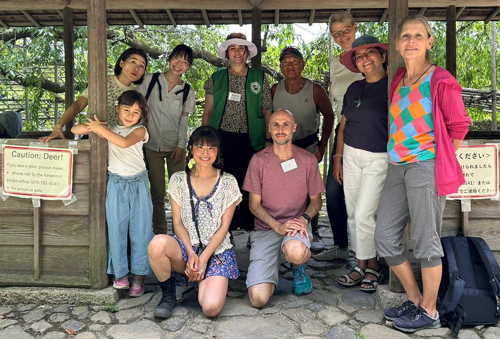
The concept of Shinrin-yoku (“immersion in the forest”) was revived in modern times in the 1980s in Japan. Holiday and tourist locations in the mountains embraced Shinrin-yoku and dozens of “Forest Therapy Bases” sprung up across all prefectures in Japan. Despite several research efforts, especially led by Prof. Dr. Yoshifumi Miyazaki and his team at Chiba University, Shinrin-yoku, unfortunately, did not become an integral part of Japan’s national health system. But it was Professor Miyazaki who realized the potential and coined the English phrase “Forest Therapy”. This allowed for Shinrin-yoku to become more aware outside Japan. Now, Forest Therapy has returned to Japan – courtesy of INFTA and the Kyoto Botanical Gardens. As a special incentive for the Public celebrating its 100th anniversary, the Kyoto Botanical Garden invited interested participants to join several Forest Therapy sessions, conducted by INFTA during 12-16 June 2024, free-of-charge. All sessions were very well attended and participants from all across Japan enjoyed and learned about the health benefits of these professionally conducted Forest Therapy sessions. As a result, INFTA – together with Professor Miyazaki and his team – will spearhead renewed efforts to professionalize and standardize Forest Therapy for it to become an integral part of Japan’s advanced health system in the near future.