INFTA-Certified Forest Therapy Tourist Guide training for Vietnam
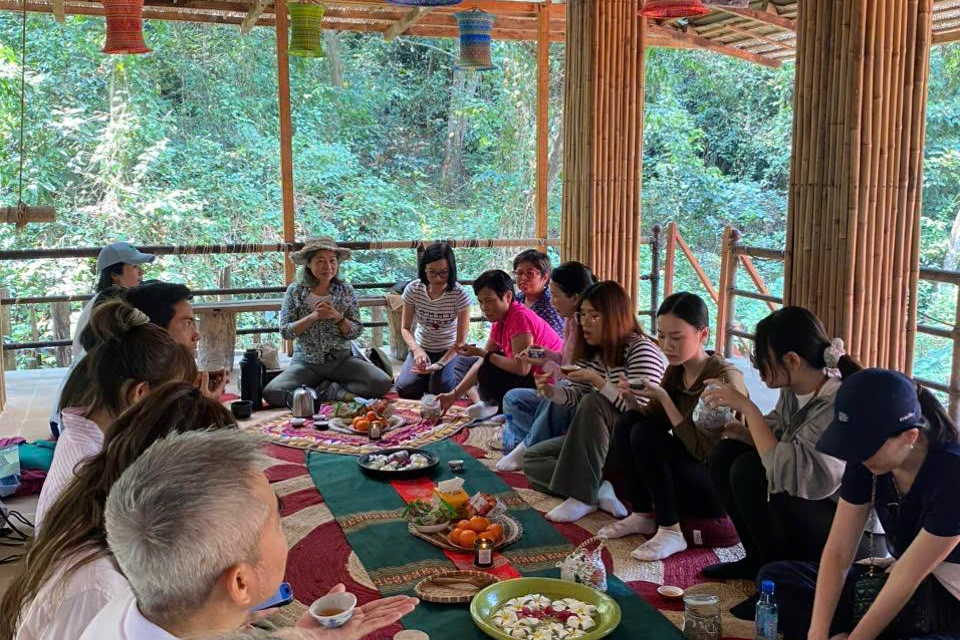
In order to advance training options for INFTA-Certified Forest Therapy Tourist Guide, INFTA´s President, Susan Joachim, paid a visit to “Fairyland”, a leading eco-resort in a forested area outside Ho Chi Minh City in Vietnam. Hosted by the first INFTA-Certified and Accredited Forest Therapy Guide in Vietnam, Mrs. Van Tran Minh, INFTA´s President had the opportunity to take part in a Forest Therapy session organized for participants seeking to de-stress, relax and experience the tranquility and clean mountain air around “Fairyland” – a most welcome get-away from the noise and pollution of the metropolitan settings in Ho Chi Minh City. Some 20 participants enjoyed the Forest Therapy session and shared a communal tea ceremony at the end of the event (see photo). In her discussion with Vietnamese stakeholders and people interested in the benefits of Forest Therapy, INFTA´s President pointed out the growing importance for training INFTA-Certified Forest Therapy Tourist Guides given the sectoral growth of the global health & wellbeing economy to more than USD 7 trillion in 2026. To find out more and apply, please click here.
INFTA-Certified Forest Therapy Tourist Guide training for the Global South
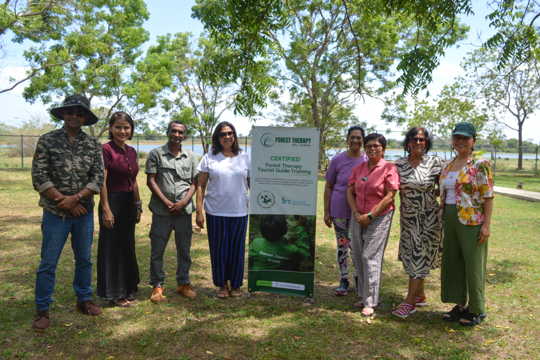
Open for applications now, INFTA is proud to offer the new Forest Therapy Tourist Guide (FTTG) training, an advanced professional pathway designed for those ready to thrive in the global health & wellbeing and wellness tourism sector. As demand grows in global wellness economy – projected to reach about USD 7 trillion in 2026 -, with wellness tourism being a major contributor, this training prepares practitioners to meet rising opportunities anywhere in the world. Delivered entirely supervised and mentored online through INFTA’s innovative Learning Management System, the FTTG course is accessible 24/7 from any location on standard digital devices. Over three months, trainees complete 168 mentored lessons, practical tasks, live mentoring and assessment, and receive comprehensive training material and access to INFTA’s extensive research database. Successful participants graduate with the INFTA Forest Therapy Tourist Guide Certificate and institutional accreditation. This internationally recognised qualification equips guides with the competencies to create safe, evidence-based Forest Therapy experiences tailored to tourists, enhancing eco-wellbeing offerings for resorts, spas, wellness centres and tour operators. Graduates can immediately tap into the expanding health & wellbeing tourism markets while contributing to Public health through nature connection practices. Begin your journey in this dynamic sector—anytime, anywhere. To find out more and apply, please click here.
Supporting youth mental health through social media detox and Forest Therapy
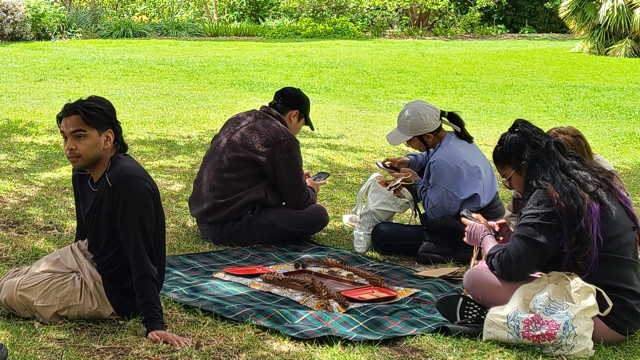
Recent research published in JAMA Network Open (2025) highlights growing evidence that structured social media detox initiatives can support improved mental health outcomes among young people. As communities respond to rising concerns around youth wellbeing, research and practice increasingly show that reducing screen time alone is not enough—what replaces digital engagement plays a critical role in shaping long-term outcomes. Guided Forest Therapy offers a research-informed, community-based complement to social media detox programs. Through intentional, sensory engagement with natural environments, Forest Therapy supports nervous system regulation, emotional awareness, attention restoration, and social connection—key protective factors for youth mental health. Delivered by trained practitioners and grounded in international standards, Forest Therapy provides a safe, inclusive, and non-clinical space that reframes “detox” as reconnection rather than deprivation. INFTA recognises Forest Therapy as an evidence-based public health practice, supported by a dynamic international training model that evolves alongside emerging research. This adaptive approach enables Forest Therapy to be ethically and effectively applied across demographics, settings, and cultures—including youth, community groups, and diverse populations—while maintaining consistency, quality, and professional integrity. As schools, youth services, local councils, and community organisations explore sustainable, preventive responses to youth mental health challenges, integrating guided Forest Therapy into social media detox initiatives represents a promising, low-risk, and scalable pathway toward lasting wellbeing. References: Calvert E, Cipriani M, Dwyer B, et al. Social Media Detox and Youth Mental Health (2025). JAMA Netw Open;8(11):e2545245. doi:10.1001/jamanetworkopen.2025.45245 Kil, N., Kim, J.G., Thornton, E., Jeranek, A. (2023). Psychological and Physiological Health Benefits of a Structured Forest Therapy Program for Children and Adolescents with Mental Health Disorders. International Journal of Mental Health Promotion, 25(10), 1117–1125. https://doi.org/10.32604/ijmhp.2023.022981
Green space is not a luxury — but Public health

A Finnish study adds striking evidence to something many of us intuitively know: contact with urban nature isn’t a luxury, it’s a Public health strategy with measurable mental and physical health benefits. It’s no surprise that researchers around the world are no longer just tracking whether people experience anxiety or depression, but why these conditions are rising — and what cities can do about it. What did the Finnish study find? Researchers analyzed responses from more than 16,000 residents in Helsinki and the surrounding area. They found that people who visited parks, community gardens, forests, or other green spaces three to four times a week had significantly lower use of prescription drugs compared to those who visited less than once a week: 33% lower odds of using medication for anxiety, depression, or insomnia 36% lower odds of use of hypertension medication 26% lower odds of using asthma medication What really stood out was that the strongest benefits were seen among lower-income residents, suggesting that access to green space could help reduce health inequalities — not just medication use. Prescription drug use was used as a proxy for ill health, meaning people spending more time in nature tended to rely less on medications for mental stress and cardiovascular conditions. Why this matters now These findings land at a time when mental health challenges are increasing worldwide: Nearly 1 billion people worldwide live with a mental disorder such as anxiety or depression (World Health Organization – WHO). The COVID-19 pandemic triggered an estimated 25% rise in anxiety and depression in its first year (WHO). Urban living — with its density, noise, pollution, and social isolation — is consistently linked to higher rates of stress-related mental health conditions (World Economic Forum). Together, this tells me that cities need solutions beyond clinics and prescriptions — solutions that address environmental and social stressors at their roots. Green space as a Public health investment Spending time in parks and gardens appears to reduce stress even without intense physical activity. And because lower-income communities often have the least access to quality green space, investing in these environments can also promote health equity. With more than half the world’s population now living in cities — a figure expected to approach 60% by 2030 — the mental health burden of urban life will only grow without structural interventions. What this means for Urban Planning Urban planning needs to treat green space as essential infrastructure. That means: Ensuring everyone can reach a green or blue space within walking distance, Designing spaces that feel safe, inclusive, and well maintained Correcting inequities in where green space is located Integrating greenery into every day routes, not just destination parks Supporting initiatives like social prescribing that encourage time outdoors A question for all of us This research reinforces a simple but powerful idea: nature supports health in measurable ways, including reduced reliance on medication. As mental health pressures continue to rise, cities have both an opportunity and a responsibility to design for well-being. So, the question is: what can citizens do — or get involved in — to ensure city planners and public officials take this kind of research seriously when planning for the future? In an era of rising anxiety and depression, urban green space is more than beauty. It is prevention. Reference: Turunen, A. W., Halonen, J., Korpela, K., Ojala, A., Pasanen, T., Siponen, T., Tiittanen, P., Tyrväinen, L., Yli-Tuomi, T., & Lanki, T. (2023). Cross-sectional associations of different types of nature exposure with psychotropic, antihypertensive and asthma medication. Occupational and environmental medicine, 80(2), 111–118. https://doi.org/10.1136/oemed-2022-108491